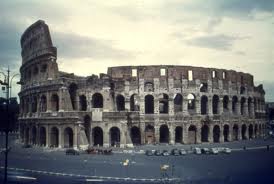
The early Christians saw the theatre as an institution based in paganism (directly against Christianity) and rooted in the ideals of self satisfying immorality. It is no wonder that the Christian Church, whose only experience with theatre was the Roman mimes, full of violence and sex, condemned theatre in Rome and in general. It was into this theatrical environment that the early Christians were introduced to Roman theatre. By the time of the early Christian fathers, theatre was "devoted to sex and sensationalism" (Harris, 1992). For a people whose religion was based on purity and moral integrity, the Roman theatre never stood a chance. (Barker, 1996) |
 | Constantine the Great Roman emperor Constantine the Great, also known as Constantine I or Saint Constantine, was Roman Emperor from 306 to 337 and was the Emperor who made Christianity legal. By 400A.D., many festivals diminished, 404A.D,. gladiators were banned and by 5223AD animal fights were also banned. 553 A.D. is the last record we have of a performance in the Roman Empire. (Trumbull,2007)
|
Many scholars believe that the death of Roman theatre was a result of Christian influence. However, the Church was not opposed to drama per se. It was opposed to the immorality at the core of Roman theatre. The true death of theatre took place over centuries of artistic decline. The Church had a large part in its legal death, but the theatre itself had already deteriorated to such a point that its collapse was inevitable. (Barker,1996)
|
Task: Processed Drama Your task is to write a short descriptive paragraph as a supporter of either the Christians or Actors of Rome.This paragraph will be used in an inclass Processed Drama concerning the conflict experienced at the official fall of the Roman Theatre. You will need to take into account the concerns of Ancient Roman society, the economic state of Rome and your personal beliefs and opinions surrounding the demise of Roman Theatre. Address questions such as was the Church solely to blame, would the decadent style of Roman theatre survived had it not been for the Church? This is your chance, after experiencing the horror, excitement, hardships and glory of the Roman Empire to express how you would have felt during the time of Ancient Rome. Have some fun! |
|
|
|

BIBLIOGRAPHY BARKER, A (1996). Speculations of the death of the RomanTheatre, Undergraduate Review, Vol. 9. Iss. I Illinoiis Wesleyan University BRADFORD, W (2011). Theater in Ancient Rome, http://plays.about.com/od/historyofthestage/a/Theater-inAncient-Rome.htm accessed 31/03/2013 BURTON, B (2002). Living Drama, Pearsons Education, Melbourne Australiathree HARRIS, J.W. (1992). Medievel Theatre in Context: An Introductions. Routledge. New York MOCOMI (2012). Gladiators: Rise and Fall www.mocomikids.com, accessed 4/04/2013 PLAUTUS (205 - 184BC). Three Dollar Day. Greek and Roman plays for intermediate grades (1993) Feardon Teachers Aids TOURELLE, L & McNAMARA, M (2010). Performance, Heinemann Harcourt Education, Port Melbourne, Victoria TRUMBULL E (2007). Roman Theatre and Drama. Nova. Northern Virginia |